JRC B2 Seminar: "Trends in Inequality of Opportunity in health over the life cycle: the role of early-life conditions" - Matija Kovacic
Abstract
This paper explores the evolution of inequality of opportunity in the prevalence of chronic diseases along the life cycle and across different birth cohorts for individuals aged 50 or older and residing in 13 European countries. We adopt an ex-ante parametric approach and rely on the dissimilarity index as our reference inequality metric. In addition to a commonly used set of circumstances, we pay particular attention to the role of adverse early-life conditions, such as the experience of harm and the quality of the relationship with parents. In order to quantify the relative importance of each circumstance, we apply the Shapley inequality decomposition method. Our results suggest that inequality of opportunity in health is not stable over the life cycle - it is generally lower at younger ages and then monotonically increases. Moreover, it varies between different birth cohorts and is generally higher for younger individuals than for older age groups. Finally, the contribution of adverse early life conditions ranges between 25% and 45%, which is comparable to the share of socio-economic circumstances but significantly higher than the relative contribution of other demographic characteristics, especially at younger ages.
Speaker
Matija Kovacic is a researcher in the European Commission's Joint Research Centre (Ispra). He is also affiliated with the Department of Economics at Ca’ Foscari University of Venice as a subject expert in Empirical Economics and Microeconomics. Before that, he was a post-doc researcher at the Ca’ Foscari University of Venice and the "Marco Fanno" Department of Economics, University of Padua. His research interests include the analysis of individual attitudes and choices; inequality; and health economics.


Seminario de Doutoramento: Esther Medina Ferreiro (Universidade de Vigo)
Abstract:
Las radiotelevisiones públicas europeas (RSPs) se han enfrentado a procesos de digitalización para poder adaptarse a los cambios sufridos en el actual ecosistema audiovisual. Las grandes empresas tecnológicas, los servicios de OTT y los servicios audiovisuales privados compiten en un escenario en el que las RSPs juegan con desventaja. En este seminario se tratará si las estrategias que están adaptando para acometer transformaciones digitales son coherentes con sus valores de servicio público y el papel de la innovación, tanto en su modelo de negocio como en el resto de su cadena de valor.
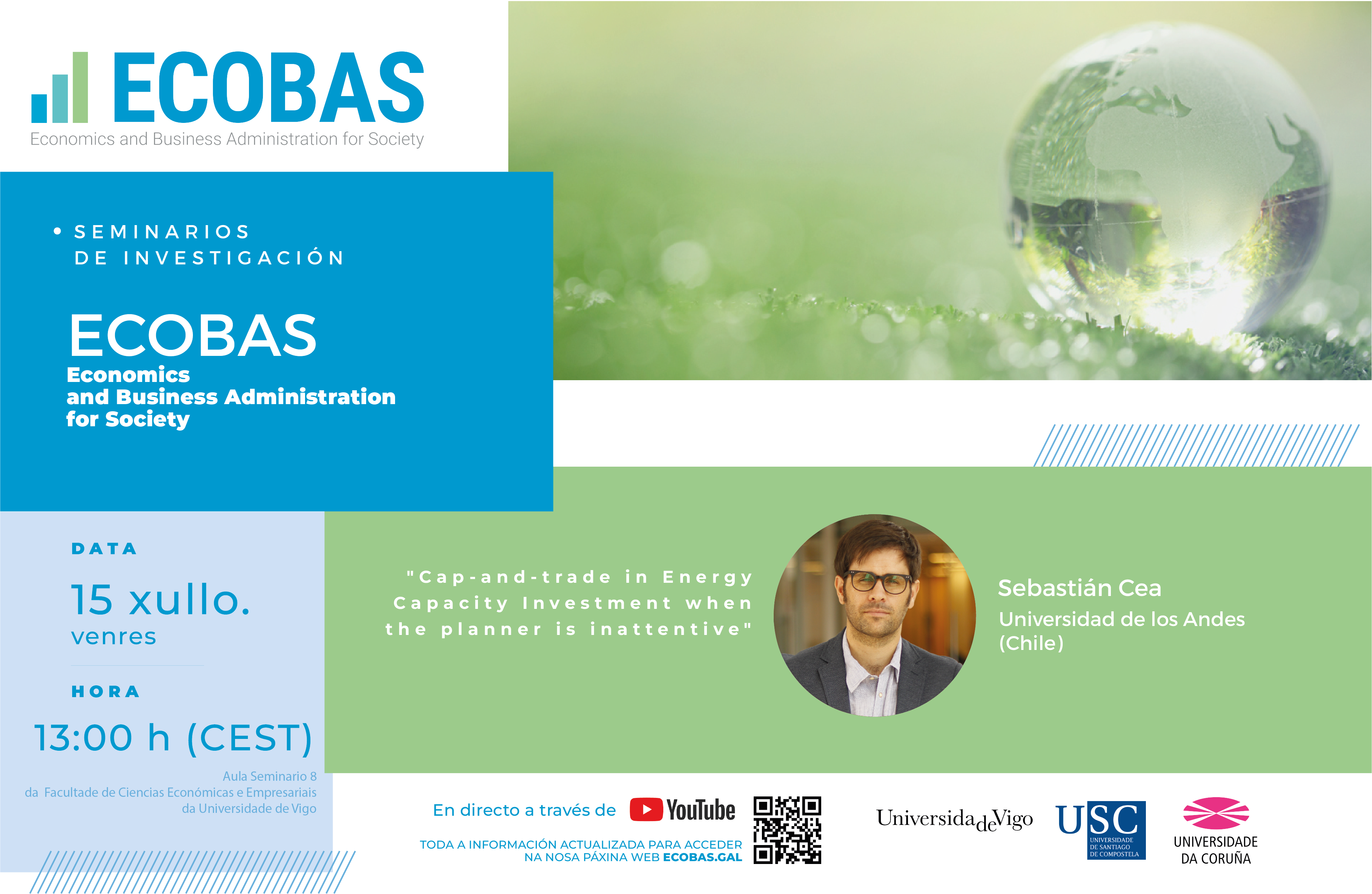
Seminario de Investigación ECOBAS: Sebastián Cea Echenique (Universidade dos Andes)
Abstract:
Nun modelo de cap and trade con inversión en capacidade de xeración eléctrica en 2 etapas con incertidumbre, incluimos atención limitada por parte do planificador social. A inclusión deste tipo de configuracións xustifícase no feito de que a fixación dun cap preciso é costosa. No noso modelo definimos dous tipos de racionalidades de planificador: unha orientada nos beneficios por venta de dereitos e outra enfocada no benestar social. Computamos o modelo para o caso chileno contrastando cos resultados de Amigo et alii (2021) e os cumplimiento de carbono neutralidade en base ao acordo de Paris. Por un lado, os resultados do modelo Profit oriented amosan un impacto significativo da precisión do cap respecto da colocación óptima de dereitos subastados. En paralelo, esta configuración entrega os prezos de electricidade máis baixos entre todos os modelos. Por outro lado, a configuración Welfare oriented emite a menor cantidade de permisos para altos orzamentos de carbono.
JRC B2 Seminar: "Public support for tax policies in COVID-19 times: Evidence from Luxembourg" - Javier Oliveira
Abstract
We study attitudes towards the introduction of hypothetical new taxes to finance the cost of the COVID-19 pandemic. We rely on survey data collected in Luxembourg in 2020. The survey asks for the agreement of respondents over: a one-time net wealth tax, an inheritance tax, a temporary solidarity income tax, and a temporary increase in VAT. All questions include different and randomly assigned tax attributes (tax rates and exemption amounts). We find a clear divide with relatively high support for new wealth and inheritance taxes on the one hand and a low support for increases in VAT and income taxes on the other hand. While 58% of respondents agree or strongly agree with a one-time tax levied on net worth, only 24% are in favor of a small increase in VAT. Support for any tax is however negatively associated with the size of the tax as measured by the predicted revenues. Our results indicate that a one-time wealth tax could raise substantial revenues and still garner public support.
Speaker
Javier Olivera is a researcher in the department of living conditions at the Luxembourg Institute of Socio-Economic Research (LISER) and full professor of economics at Pontificia Universidad Catolica del Peru (PUCP). He is also affiliated to the department of economics at KU Leuven. Before his academic career he worked in the public sector, advising policy in Peru. His research interests include public economics, socio-economic inequality, pensions, attitudes towards redistribution and taxation, intergenerational transfers, old age and economic demography.

Seminario de Doutoramento: Miguel Carbonell Valin (USC e de Vigo)
"A importancia do networking no liderado relacional"
Venres 1 de xullo ás 13.00h (CEST)
SEMINARIO EN MODALIDADE MIXTA
Presencial: Aula seminario 8 da Facultade de Ciencias Económicas e Empresariais da Universidade de Vigo
A TRAVÉS DE ZOOM
Enlace: https://us06web.zoom.us/j/88575216249?pwd=MC9DYko5MDdyQWtUWE9OZDRHTzI1Zz09
885 7521 6249
841421
* Se participas neste seminario e precisas un certificado de asistencia ao mesmo, por favor envía un correo a . Se a túa asistencia é virtual, deberás conectarte empregando o teu nome e apelidos.